Unlocking Affordable and Accessible AI Solutions for Small Businesses and Entrepreneurs
- Rocio Bravo
- Feb 23, 2024
- 13 min read

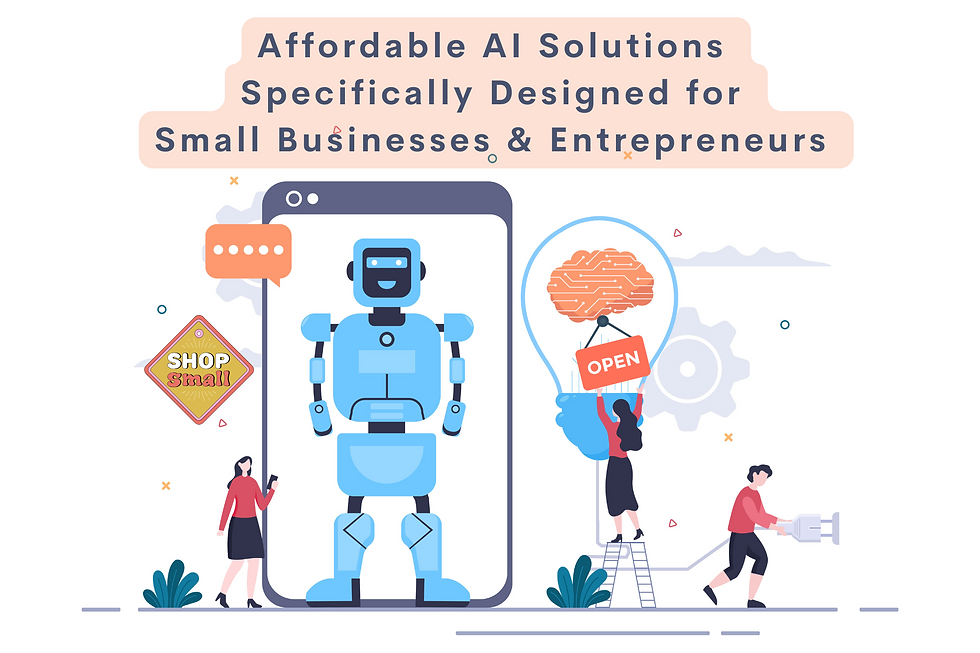
In today's rapidly evolving business landscape, AI-powered solutions have become increasingly accessible and affordable for small businesses and entrepreneurs. This topic aims to unveil the potential of AI tools and solutions that can be easily implemented by small businesses, debunking the myth that AI is exclusively reserved for large corporations. By exploring these affordable and accessible options, we hope to demystify AI for small business owners and regular individuals, highlighting its relevance and benefits in driving success in any industry.
Examples of AI-powered solutions for small businesses
AI-powered solutions are becoming increasingly accessible and affordable for small businesses. For example, a small retail store can use AI algorithms to analyze customer data and make personalized product recommendations. This can lead to increased sales and customer satisfaction. Another example is AI-powered chatbots that can handle customer inquiries and provide support 24/7, reducing the need for human customer service representatives.
Additionally, AI can be used in inventory management systems to optimize stock levels and predict demand patterns. This helps small businesses avoid overstocking or running out of popular items, leading to improved efficiency and cost savings. In the healthcare industry, AI tools can assist with medical diagnosis by analyzing patient data and providing insights to healthcare professionals.
Personalized product recommendations:
AI algorithms can analyze customer data such as purchase history, browsing behavior, and demographic information to make personalized product recommendations. This not only improves the shopping experience for customers but also increases the likelihood of making a sale.
AI-powered chatbots:
Chatbots are virtual assistants that use natural language processing (NLP) algorithms to communicate with customers in real time. They can answer frequently asked questions, provide support, and even process orders. Chatbots offer 24/7 availability, reduce response times, and free up human resources for more complex tasks.
How AI tools can streamline operations and increase efficiency for small businesses
AI tools have the potential to streamline operations and increase efficiency for small businesses in various ways. One such way is through automating repetitive tasks that consume valuable time and resources. For example, AI-powered software can automatically sort and categorize emails or invoices, saving employees hours of manual work.
In addition to automation, AI tools can also analyze large amounts of data quickly and accurately, providing valuable insights for decision-making. For example, AI algorithms can analyze sales data to identify trends and patterns, helping small businesses optimize their marketing strategies or adjust inventory levels.
Automation of repetitive tasks:
AI tools can automate tasks such as data entry, document processing, and customer support inquiries. This frees up employees' time to focus on more strategic and creative tasks that require human expertise.
Data analysis and insights:
AI tools can process large volumes of data in real time and provide actionable insights. For example, AI-powered analytics platforms can analyze customer behavior data to identify opportunities for upselling or cross-selling, leading to increased revenue.
Affordable AI solutions designed specifically for small business owners
In the past, AI solutions were often expensive and complex, making them inaccessible for many small business owners. However, with advancements in technology and increased competition in the market, there are now affordable AI solutions specifically designed for small businesses.
These affordable AI solutions typically offer user-friendly interfaces that do not require extensive technical expertise to operate. They may also come with flexible pricing options such as monthly subscriptions or pay-as-you-go models, allowing small businesses to scale their usage based on their needs.
User-friendly interfaces:
Affordable AI solutions designed for small businesses often prioritize ease-of-use with intuitive interfaces that do not require coding or technical skills. This enables small business owners without a background in technology to easily implement and utilize these tools.
Flexible pricing options:
To make AI solutions accessible to small businesses with limited budgets, many providers offer flexible pricing options such as monthly subscriptions or pay-as-you-go models. This allows small businesses to start with a lower investment and scale their usage as their needs grow.
AI benefiting regular people, not just large corporations: An explanation
While AI is often associated with large corporations and tech giants, it is also benefiting regular people and small businesses in numerous ways. AI technologies are becoming more accessible and affordable, enabling individuals and small business owners to leverage their capabilities for various purposes.
For example, AI-powered virtual assistants like Siri or Alexa have become commonplace in households, helping with tasks such as setting reminders, playing music, or providing information. These virtual assistants use AI algorithms to understand natural language and provide personalized responses.
Virtual assistants:
Virtual assistants powered by AI algorithms are now widely available to regular people through devices like smartphones or smart speakers. These virtual assistants can perform tasks such as answering questions, setting reminders, or even controlling smart home devices.
Personalized recommendations:
AI algorithms are used in various applications to provide personalized recommendations to users. For example, streaming platforms like Netflix use AI algorithms to suggest movies or TV shows based on user's viewing history and preferences.
Potential cost savings associated with implementing AI in small businesses
Implementing AI solutions can lead to significant cost savings for small businesses in the long run. While there may be initial investments involved in acquiring and implementing AI tools, the benefits outweigh the costs over time.
One area where cost savings can be realized is through automation of repetitive tasks. By automating tasks that would otherwise require manual labor, small businesses can reduce labor costs and allocate resources more efficiently.
Labor cost reduction:
AI tools can automate repetitive tasks that would otherwise require human labor. This reduces the need for additional employees or frees up existing employees to focus on more strategic and creative tasks, ultimately reducing labor costs.
Improved efficiency:
AI tools can streamline operations and improve efficiency by automating processes, optimizing workflows, and providing valuable insights. This leads to time savings, reduced errors, and overall cost savings for small businesses.
User-friendly AI tools available for entrepreneurs without technical expertise
Entrepreneurs without technical expertise can still benefit from AI tools thanks to the availability of user-friendly platforms and solutions. These tools are designed with simplicity in mind, allowing users to leverage AI capabilities without requiring deep knowledge of programming or data science.
Many user-friendly AI tools provide intuitive interfaces that guide users through the process step-by-step. They may also offer pre-built models or templates that can be customized to meet specific business needs. Additionally, some platforms provide resources such as tutorials, documentation, or customer support to assist users in utilizing AI effectively.
Intuitive interfaces:
User-friendly AI tools often feature intuitive interfaces that make it easy for entrepreneurs without technical expertise to navigate and utilize the tool's functionalities. These interfaces may include drag-and-drop features or visual workflows that simplify the process of building and deploying AI models.
Pre-built models and templates:
To cater to users without programming skills, many user-friendly AI platforms offer pre-built models or templates that can be easily customized. This allows entrepreneurs to leverage existing AI capabilities without needing to start from scratch.
Enhancing customer service with AI-powered chatbots for small businesses
A popular application of AI in small businesses is the use of chatbots for customer service. Chatbots powered by natural language processing (NLP) algorithms can handle customer inquiries, provide support, and even process orders. Implementing AI-powered chatbots can enhance the customer service experience in several ways.
Firstly, chatbots offer 24/7 availability, allowing customers to get assistance at any time, even outside of regular business hours. This improves customer satisfaction by reducing response times and ensuring timely support. Secondly, chatbots can handle multiple inquiries simultaneously, eliminating the need for customers to wait in queues or be put on hold. This increases efficiency and allows small businesses to serve more customers at once.
24/7 availability:
AI-powered chatbots can provide customer support round the clock, ensuring that customers can get assistance whenever they need it. This improves customer satisfaction and builds trust in the brand's commitment to providing excellent service.
Simultaneous handling of inquiries:
Unlike human customer service representatives who can handle one inquiry at a time, chatbots have the ability to handle multiple inquiries simultaneously. This reduces waiting times for customers and allows small businesses to efficiently manage high volumes of inquiries.
Real-life case studies of successful AI implementation in small businesses
There are numerous real-life examples of small businesses successfully implementing AI solutions to improve their operations and achieve business goals. These case studies highlight how AI has helped small businesses increase efficiency, reduce costs, and enhance their products or services.
One example is a small e-commerce company that used AI algorithms to analyze customer data and personalize product recommendations. By offering personalized recommendations based on individual preferences and browsing behavior, the company saw a significant increase in sales conversions and higher average order values.
Small e-commerce company:
A small e-commerce company implemented an AI-powered recommendation engine that analyzed customer data such as purchase history and browsing behavior. The AI algorithms used this data to provide personalized product recommendations to customers, resulting in a 20% increase in sales conversions and a 15% increase in average order value.
Restaurant chain:
A small restaurant chain implemented an AI-powered inventory management system that predicted demand patterns and optimized stock levels. This reduced food waste by 30% and improved overall efficiency by ensuring the availability of popular ingredients while minimizing excess inventory.
The steps involved in implementing an AI solution for a small business
Implementing an AI solution for a small business involves several key steps to ensure successful integration and utilization of the technology. While the specific steps may vary depending on the nature of the business and the chosen AI solution, there are common stages that most small businesses go through when adopting AI.
1. Define objectives and requirements:
Identify the specific goals or challenges that the AI solution aims to address within your small business.
Determine the requirements, such as data sources, infrastructure, or expertise needed to implement and utilize the AI solution effectively.
2. Research available solutions:
Conduct research to identify AI solutions that align with your objectives and requirements.
Evaluate different vendors or platforms based on factors such as cost, features, ease-of-use, and customer reviews.
3. Pilot testing:
Select one or more potential AI solutions for pilot testing within your small business.
Define clear metrics or KPIs to measure the effectiveness of the pilot test.
4. Integration and implementation:
If the pilot test is successful, proceed with the integration and implementation of the chosen AI solution.
Ensure proper integration with existing systems or processes and provide necessary training to employees.
5. Monitor and evaluate:
Continuously monitor the performance and impact of the implemented AI solution on your small business.
Evaluate whether the solution is meeting your objectives and make adjustments if necessary.
Ethical considerations when using AI tools for small business owners
When implementing AI tools in small businesses, it is important for business owners to consider ethical implications and ensure the responsible use of these technologies. Ethical considerations can help prevent biases, protect privacy, and maintain transparency in the use of AI tools.
Bias mitigation:
Avoid biased data or algorithms that may result in discriminatory outcomes for certain groups or individuals.
Regularly review and audit AI systems to identify and address any biases that may emerge over time.
Privacy protection:
Ensure compliance with relevant data protection regulations when collecting, storing, or processing customer data using AI tools.
Anonymize or pseudonymize personal data when possible to protect individuals' privacy.
Transparency and explainability:
Strive for transparency in how AI tools are used within your small business by providing clear explanations to customers or employees about how their data is being utilized.
Avoid using "black box" AI systems that cannot be explained or understood by humans, as this may raise concerns about accountability and trustworthiness.
How AI assists with data analysis and decision-making processes in small businesses
AI plays a crucial role in data analysis and decision-making processes for small businesses by processing large volumes of data quickly and accurately. AI algorithms can identify patterns, trends, or anomalies in the data that may not be easily detectable by humans.
By leveraging AI tools for data analysis, small businesses can make more informed decisions based on evidence and insights derived from their own data. This can lead to improved efficiency, better resource allocation, and increased competitiveness.
Data processing and analysis:
AI tools can process large volumes of structured and unstructured data quickly, allowing small businesses to extract valuable insights from their data.
AI algorithms can identify patterns, trends, or anomalies in the data that may not be easily detectable by humans.
Decision support:
By providing accurate and timely insights, AI tools assist small businesses in making more informed decisions.
AI algorithms can analyze historical data to predict future outcomes or recommend optimal strategies for achieving business goals.
Industries where AI has proven particularly beneficial for small businesses
A wide range of industries have seen significant benefits from implementing AI solutions in their operations. However, some industries have experienced particular advantages due to the nature of their business processes or the availability of relevant datasets. Here are a few examples:
E-commerce:
In the e-commerce industry, AI-powered recommendation systems have proven highly effective in increasing sales conversions by providing personalized product suggestions based on customer preferences and behavior.
Healthcare:
In healthcare, AI tools have been used for medical image analysis to assist doctors in diagnosing diseases such as cancer more accurately and efficiently. AI algorithms can analyze medical images and identify potential abnormalities or patterns that may indicate certain conditions.
Manufacturing:
In the manufacturing industry, AI-powered predictive maintenance systems have helped small businesses reduce downtime by detecting potential equipment failures before they occur. By analyzing sensor data and historical maintenance records, AI algorithms can predict when machinery or equipment is likely to fail and schedule maintenance accordingly.
Challenges and barriers when adopting AI solutions for small businesses
While there are numerous benefits to adopting AI solutions for small businesses, there are also challenges and barriers that need to be considered. These challenges include technical complexities, cost considerations, data privacy concerns, and a lack of awareness or understanding of AI among small business owners.
Technical complexities:
Implementing and integrating AI solutions may require technical expertise that small business owners or employees may not possess.
There may be compatibility issues with existing systems or infrastructure that need to be addressed during the implementation process.
Cost considerations:
The initial investment required for acquiring and implementing AI tools can be a barrier for small businesses with limited budgets.
Ongoing costs such as maintenance, training, or data storage should also be taken into account when considering the affordability of AI solutions.
Data privacy concerns:
The use of AI tools often involves collecting and processing large amounts of customer data, raising concerns about data privacy and security.
Small businesses must ensure compliance with relevant data protection regulations and take measures to protect customer information from unauthorized access or misuse.
Lack of awareness or understanding:
Many small business owners may lack awareness or understanding of AI technologies and their potential benefits.
Education and training initiatives can help bridge this knowledge gap and empower small business owners to make informed decisions about adopting AI solutions.
Online Marketplaces
AI Marketplace
One of the best resources for finding affordable AI tools for small business owners is online marketplaces dedicated to AI solutions. These platforms bring together a wide range of AI tools and technologies from various vendors, allowing small business owners to compare and choose the most suitable options for their needs. One such marketplace is the AI Marketplace, which offers a diverse selection of AI tools ranging from chatbots and virtual assistants to predictive analytics and image recognition software. By browsing through these platforms, small business owners can find affordable AI tools that can automate tasks, improve customer experience, and enhance decision-making processes.
Benefits:
- Wide variety of AI tools available in one place
- Opportunity to compare prices and features
- Possibility to read reviews and ratings from other users
E-commerce Platforms
Another resource for finding affordable AI tools is e-commerce platforms that specialize in selling technology products. These platforms often have dedicated sections for artificial intelligence, where small business owners can explore different tools specifically designed for their industry or business size. For instance, popular e-commerce platforms like Amazon or Shopify offer a wide range of AI-powered applications, plugins, and software that can be easily integrated into existing systems. Small business owners can benefit from browsing these platforms as they provide an extensive selection of affordable options tailored to their specific needs.
Benefits:
- Easy integration with existing systems
- Specialized tools for different industries
- Transparent pricing and customer reviews
Open-source Communities
Open-source communities are another valuable resource for finding affordable AI tools for small business owners. These communities consist of developers who collaborate on creating free or low-cost AI solutions that are accessible to everyone. Small business owners can take advantage of open-source projects by accessing and customizing AI tools according to their specific requirements. Platforms like GitHub and GitLab are popular open-source communities where developers share their projects, including AI frameworks, libraries, and algorithms. By exploring these platforms, small business owners can find affordable AI tools that can be tailored to their unique business needs.
Benefits:
- Access to free or low-cost AI solutions
- Opportunity for customization and adaptation
- Active community support
Industry-specific Associations
Industry-specific associations or organizations often provide resources and recommendations for small business owners looking for affordable AI tools. These associations focus on supporting businesses within a particular sector by providing insights into the latest technologies and tools available. For example, if a small business operates in the healthcare industry, associations like the American Medical Association or Health Information Management Systems Society (HIMSS) may offer guidance on affordable AI tools specifically designed for healthcare providers. By reaching out to these associations or exploring their websites, small business owners can find valuable recommendations and resources.
Benefits:
- Tailored recommendations for specific industries
- Insights into industry trends and best practices
- Networking opportunities with other businesses in the same sector
Conclusion
In conclusion, affordable and accessible AI solutions are now within reach for small businesses and entrepreneurs. These AI-powered tools can streamline operations, increase efficiency, and enhance customer service. By implementing AI solutions, small businesses can benefit from cost savings, data analysis capabilities, and personalized recommendations. It is important for small business owners to consider ethical implications and ensure responsible use of AI technologies. Despite challenges such as technical complexities and cost considerations, the potential benefits of adopting AI solutions make it a worthwhile investment for small businesses looking to stay competitive in today's digital age.
Summary
Unlocking Affordable and Accessible AI Solutions for Small Businesses and Entrepreneurs Small businesses and entrepreneurs can benefit greatly from AI automation by streamlining operations, improving efficiency, and making better decisions. There are affordable AI solutions available that can help in scaling operations and increasing productivity. However, key challenges such as cost and data security need to be considered when adopting AI technology. By integrating AI into marketing strategies, small businesses can stay competitive in the market. It is important for entrepreneurs to choose the right AI solutions that align with their business goals. Overall, embracing AI technology can lead to significant growth opportunities for small businesses while overcoming barriers to adoption.
Contact Us
The power of AI automation isn't just a privilege for the big players; it's an accessible reality for entrepreneurs and small businesses alike. At RedPrompt Studio, we specialize in bridging the gap between these cutting-edge technologies and your unique business needs. Don't let misconceptions hold you back from exploring the vast potential of AI. Embrace the opportunity to streamline your operations, enhance productivity, and stay ahead in your industry.
Ready to transform your business with AI? Contact RedPrompt Studio today to book your AI Consultation. Let's unlock the future of your business together – the time to get on board with AI is now.


Comments